Description
Object description
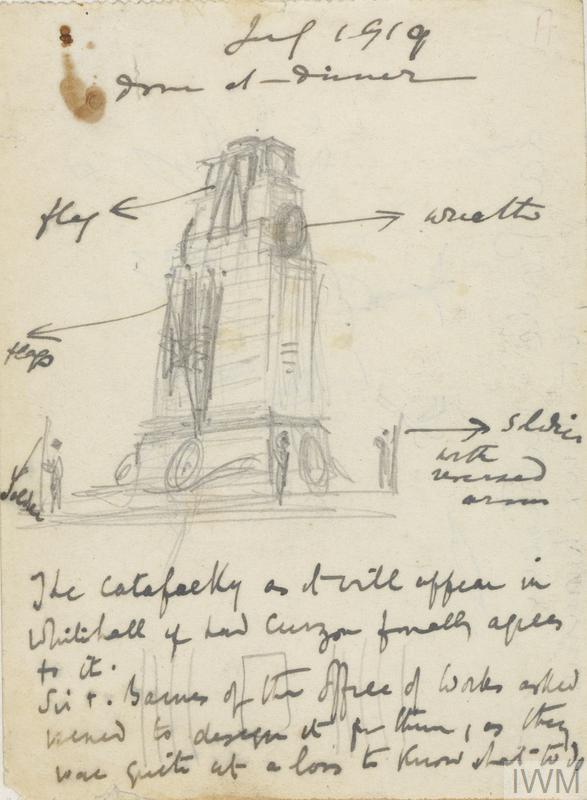
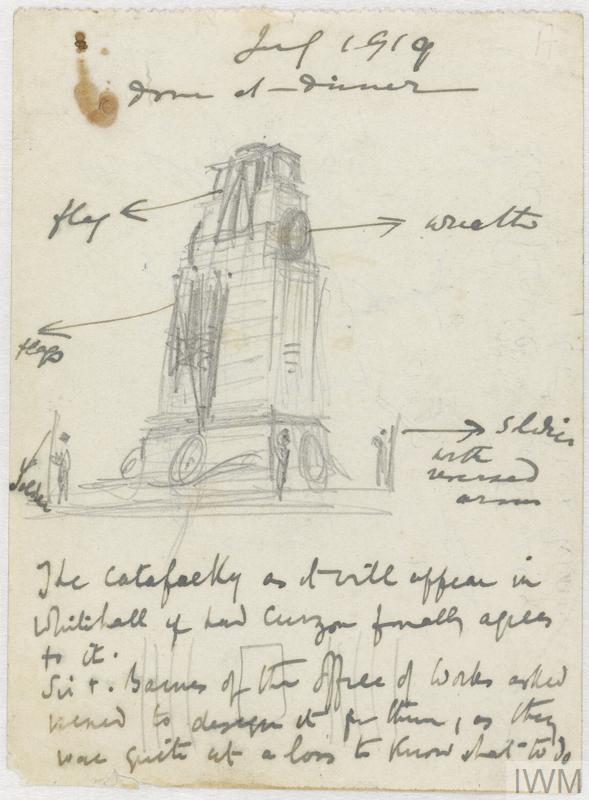
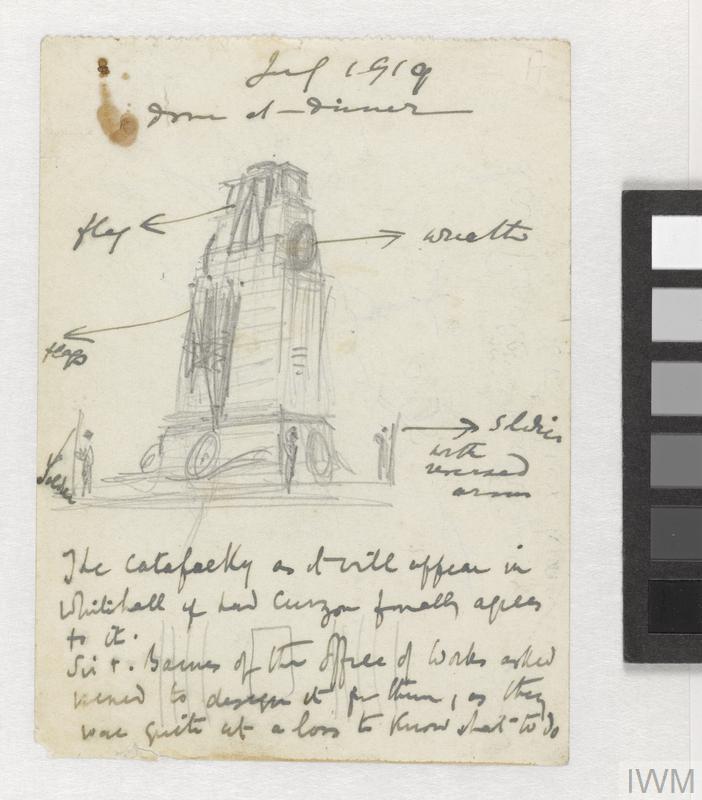
image: A sketch of the proposed design for the cenotaph with explanatory notes.
text: The catafalky (sic) as it will appear in Whitehall if Lord Curzon finally agrees to it. Sir T Baines of the office of works asked
McNed to design it for them, as they were quite at a loss to know what to do. [July 1919, inscription written by Lady Sackville, with
arrows indicating flag, wreath, flags, soldier, soldier with reversed arms.]
image verso: The drawing of a Chicken.
text verso: La poule intrigeant et Bux homme
Label
Lutyens was first approached informally by Sir Alfred Mond, First Commissioner of Works in Lloyd George's government in
June 1919, to design a monument to mark the signing of the Peace Treaty. Following discussions with Clemenceau and the Peace Celebrations
Committee, Lloyd George met Lutyens in early July 1919 and asked him to design a catafalque for Whitehall, to be part of the Peace Day
events on 19th July. Lutyens' alternative suggestion of a cenotaph was agreed. Later that day Lutyens presented drawings to Sir Frank
Baines, based on his previous design for Mond. These sketches were drawn over dinner with Lady Sackville in the evening, and annotated by
her.
The final design was based on measurements of the Parthenon. In the classical manner, all the surfaces were subtly curved; the verticals
would meet at a point 1000 feet above the ground and the horizontals, 900 feet to the side. Stripped of all literal elements (at Lutyens'
insistence four soldiers at the base were not included), the simplicity and dignity of the monument became the immediate focus for national
grief.
The wood and plaster structure was unveiled on 18th July and was originally intended to stand for a week. Its extraordinary popularity
extended this to January 1920 when the weather finally forced its removal. In the meantime a slightly revised design was accepted by the
Cabinet for a permanent memorial, again sited in Whitehall and unveiled on Armistice Day, 1920. The Cenotaph remains the central focus of
remembrance.
Inscription
July 1919, inscription written by Lady Sackville, with arrows indicating flag, wreath, flags, soldier, soldier with
reversed arms. The catafalky (sic) as it will appear in Whitehall if Lord Curzon finally agrees to it. Sir T Baines of the office of works
asked McNed to design it for them, as they were quite at a loss to know what to do.
Inscription
La poule intrigeant et Bux homme